Beyond Human-Centered: When History, Culture, and Tribe Set the Brief
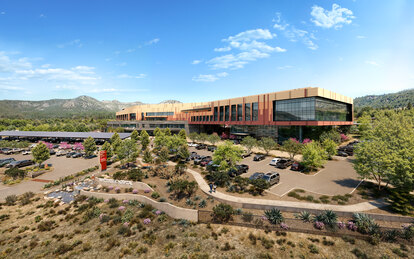
SmithGroup approached the 400,000-square-foot Whiteriver Indian Hospital as a project defined not by program or precedent, but by deep engagement with Apache history, culture, and land. Every design decision was shaped by what the community shared. The result is a building that reflects a living culture: grounded in ancestral land, oriented toward a future the tribe continues to define for itself. Beyond its architectural achievement, the project offers a broader argument for what human-centered design can become when history, culture, and community sovereignty set the brief—and when listening is treated not as a preliminary step, but as the work itself.
God formed us out of mud and breathed in us and created us, the People. That’s where our story began. We’re living in our ancestral land; our people have not moved. . . That history, of where we came from, needed to be told and retold within this hospital.
Eddie Gloshay
Director of Laboratory Services, Whiteriver Indian Hospital
In Whiteriver, Arizona, the land does not need interpretation. Set within the White Mountains, shaped by elevation, water, and time, it already carries history and obligation. When the design team first walked the remote high country site for the new Whiteriver Indian Hospital, it was clear architecture wouldn’t set the agenda. The work had to begin with listening.
For the White Mountain Apache people, place is inseparable from identity. Teachings shared early in the design process described the Apache people as having been formed from the earth—the same earth that would hold the new hospital. From the outset, that understanding reframed the work: nothing built here can be neutral, because the land is not neutral. It holds memory.
Before a line was drawn, the work began in conversation. Culture was not approached as a theme, but as knowledge—informing direction, setting limits, and clarifying priorities. Tribal members, elders, caregivers, and staff were not asked to supply symbolism; they were engaged as people who live the realities the hospital would need to support: long travel distances, the centrality of family, ceremony, grief, recovery, and work that repeats day after day. The goal was not to distill Apache culture into a recognizable design language, but to let what was shared—stories, needs, and patterns of life—shape the building itself.
The work was never about preservation in a static sense. It was about continuity—honoring what has been carried here across generations while recognizing that the White Mountain Apache Tribe is not frozen in time. For the design team, this required discipline as much as creativity: a willingness to slow down, to listen more than speak, and to allow what was heard to meaningfully alter the work.
Reflections from the design process (Lyle Steely)
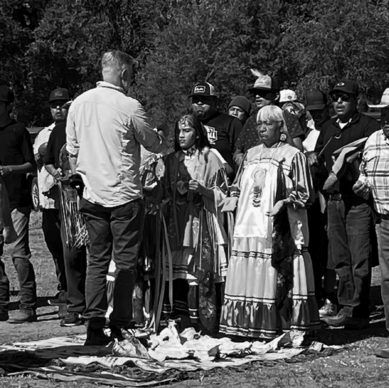
Early on, you could feel the skepticism. That shifted slowly, until months in someone who’d been visibly guarded invited us to a ceremony for his grandniece. We hadn’t asked or expected it. It was offered.
That mattered—not as approval, but as a reminder we were there to witness, not translate. We understood then that not every story becomes architecture.
WHERE STORY AND BUILDING CAME TOGETHER
One particular focus surfaced early and returned often: water.
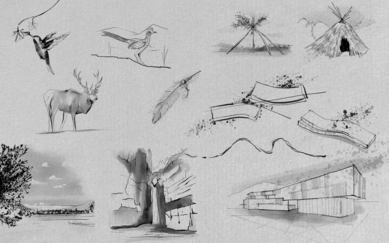
For the Apache people, water is life—not as metaphor, but as fact. It is tied to survival, belief, culture, and land. To conceptualize the building and the site, the SmithGroup design team first studied the White River and the movement of rainwater across the landscape—where it gathered, where it redirected, how the land received it.
Instead of imposing a rigid form against that logic, the hospital was shaped to move with it. The building bends and steps with the terrain, following the contours of the river gorge rather than resisting them. From a distance, the architecture feels grounded and familiar, as though shaped by the same forces that shaped the surrounding cliffs. For patients and families arriving during vulnerable moments, that sense of harmony establishes calm before a single door is opened.
Inside, the influence of water continues more quietly. Circulation paths curve and unfold naturally, guiding people intuitively. Movement through the hospital is meant to feel continuous in a sequence that supports orientation without constant decision‑making. In a place where stress is already high—where people are waiting, worrying, restless—the building carries some of the burden, reducing friction where it can.
People‑centered design in Whiteriver also meant recognizing that healing is not singular: physical care exists alongside spiritual, emotional, and cultural well-being. With that understanding, traditional healing spaces are integrated throughout the hospital, both indoors and outdoors. These spaces support ceremonial practices led by Apache medicine people, acknowledging deep-rooted healing traditions. Their presence is not symbolic, but part of everyday life and care in Whiteriver today.
The surrounding landscape extends that approach, planted with traditional medicinal species alongside familiar plants found along the river and in the mountains. Together, the building and landscape reinforce a continuum of care grounded in place.
Reflections from the design process (Lyle Steely)
Watching and listening changed the design in very real ways—how the building sits on the land, how it bends with the terrain, how little we tried to impose. Once we stopped forcing form, the right moves became clear.
WHEN THE BUILDING BEGAN TO BELONG
Material choices reinforce this sense of belonging. The exterior terracotta rainscreen carries the color and texture of the red clay earth, rooting the building in the Apache origin story. Its varied tones echo nearby mountain cliffs and recall pigments used in traditional ceremonies. Terracotta is also practical: durable, tactile, and responsive to light. It reads as grounded rather than glossy, holding warmth without demanding attention. The building does not announce itself as an object apart from its surroundings; it emerges from them.
Some of the most intentional design choices are reserved for the people who work there—those who will pass through the building not at moments of ceremony but at the beginning of an ordinary shift.
At the staff entrance, a colored glass installation filters daylight into bands of light that shift as the sun moves across the sky. The concept draws from an Apache story of a woman who reached into a mountain waterfall and caught a rainbow in her hands, receiving healing power through its light. Rather than illustrating the story directly, the installation echoes its conditions—light, movement, change. As caregivers walk into the hospital each day, the bands of light move across their path, a quiet moment of reflection before their work begins. This subtle gesture is a reminder that caregiving is both a responsibility and an act of resilience.
Inside patient spaces, cultural meaning is carried with similar restraint. The Apache understanding of cardinal directions and corresponding colors informed decisions throughout the hospital, particularly in Labor and Delivery. Black, symbolizing the beginning of life, anchors the birthing environment. The bed sits on black flooring, beneath a black soffit, against a black headwall: a clear, intentional composition, not an accent. Nearby, the birthing tub area features custom wall graphics in black and bold red, a color associated with honor and protection for Apache women during pregnancy. The effect is not theatrical but purposeful. These moments of symbolism frame birth as both a medical event and a cultural threshold—something that deserves dignity beyond the standard vocabulary of delivery rooms.
Reflections from the design process (Interior Designer Nichole Hagen)
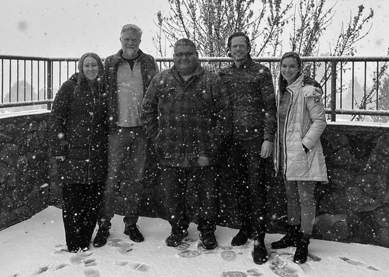
We were in Whiteriver wrapping up our final round of design meetings when it started to snow. Eddie Gloshay told us it was the second snow of the season, a sign of luck and goodwill from the Ga'an, the Mountain Spirits. He said how rare it was that we happened to be there to see it, and it really felt like an affirmation of everything we had put into the project. Lyle still has a mason jar of that snow in his freezer.
What makes these choices convincing is their consistency. They appear across scales, from siting to circulation to material to a moment of light, suggesting a process guided by attention rather than by the desire to “express” culture. The building does not treat Apache history as a backdrop. It treats it as present tense: lived, practiced, carried forward. It responds to the land it occupies, to the stories shared by the White Mountain Apache People, and to long‑held knowledge of what healing requires. Design decisions are shaped by those inputs, not layered on top of them.
There is a broader lesson here for healthcare design. This project argues—quietly, through the accumulation of decisions—that listening can be a design act. It demonstrates how people‑centered design, grounded in respect, can shape places that truly serve the communities they are built for.
Not a monument, not a brand statement—a building that recognizes where it is, who it serves, and what it owes.
The design of the hospital reflects what’s important to Apache people. . . I feel like we’ve been waiting for a hospital like this for years. I’m very thankful for our designers. They listened, they took what they saw, and they put it into our building.
Bobbi Nashio
Management Analyst, Whiteriver Indian Hospital