Flexibility and Human-Centered Design Will Define the Next Decade
Healthcare is no longer evolving in predictable cycles. Workforce burnout, demographic pressures, and rapid technological advancements are forcing a reckoning as rising costs and shrinking margins threaten the sustainability of care delivery. The result is an industry operating in a near‑constant state of recalibration.
For designers, the central question has changed: we aren’t deciding what to build next, we’re determining what the future will demand of us before it arrives. The pace of change has shattered the illusion that stability will return. Success will belong to organizations willing to design for volatility—creating environments that can flex, absorb shocks, and support clinicians and patients through whatever comes next.
SmithGroup teams are confronting these pressures in real time. I’ve been talking with our senior leaders about the macro forces reshaping our industry, while engaging next-generation designers who are excited to push the traditional boundaries of healthcare spaces. Their combined insights lead to a shared conclusion: the future of care will not be defined by a single innovation or building type, but by a network of environments that are more adaptable, intelligent, and attuned to human experience than anything we have built before.
The choices we make now—about flexibility, integration, technology, sustainability, and resilience—will determine whether the facilities we design today remain relevant five years from now. The insights that follow are not predictions; they are signals of a future already taking shape.
TECHNOLOGY WILL TRANSFORM CARE DELIVERY, BUT HUMAN-CENTERED DESIGN WILL REMAIN THE GUIDING PRINCIPLE
As artificial intelligence and automation accelerate, designers are increasingly challenged to integrate these advanced technologies without compromising the human experience.
"AI and advanced technologies will soon be embedded in every facet of care—from diagnostics to workflow—and it will change everything about how care is delivered,” says Vince Avallone, Health Planning Director. “For me, the challenge is making sure care spaces remain human-centric as they become more tech-enabled.”
Health Design Director Sam D’Amico is even more blunt about the AI hype: “AI is not the ‘easy button,’ whether in medicine or design. It’s a tool. It can be very useful for exploring possibilities, but those ideas originate in human creativity and intuition.”
In a market defined by volatility, Avallone sees a clear mandate: “Strategic insecurity is everywhere— shifting budgets, mergers, leadership changes. The answer isn’t to scale back our ambitions, it’s to plan for flexibility—standards that evolve and spaces that adapt without compromising performance.”

Disrupting the
Healthcare Status Quo
Healthcare’s next frontier is here. Explore SmithGroup's vision
for an AI-driven future—where technology transforms care and
design adapts to what’s next.
Learn more →
THE SHIFT OF HIGHER-ACUITY CARE TO AMBULATORY SETTINGS WILL CONTINUE, DEMANDING HIGH-PERFORMING, FLEXIBLE BUILDINGS
High-acuity ambulatory care is evolving quickly as more complex procedures move to the outpatient setting. “The most significant trend I’m seeing is flexibility,” says Architect and Medical Planner Kierstyn Feldlavy. “Pre- and post-procedure bays built to a higher acuity level can flex as demand shifts, and modular ORs are becoming essential as procedures and technology evolve.”
Still, assumptions about the ambulatory setting persist. “A common misconception is that ambulatory facilities can rely on scaled-down solutions. High-acuity care demands the same rigor as inpatient environments—often with greater pressure on efficiency and experience,” explains Feldlavy.
Architect Annie Chiang notes the broader community implications: “I love seeing health systems reach people where they live. Ambulatory centers are becoming community assets, and design can reflect local culture while improving access.”
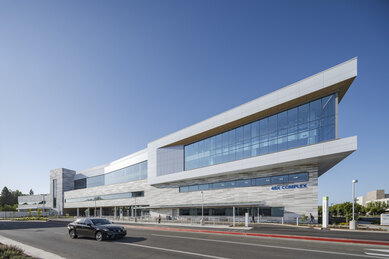
UC Davis Health 48X Complex
One of the nation’s largest and most technologically advanced
outpatient surgery centers, redefining care through cutting-edge
systems and a forward-thinking, patient-focused design.
CANCER CENTERS WILL RAPIDLY EVOLVE TO INTEGRATE ADVANCED DIAGNOSTICS AND PRECISION THERAPIES
Cancer care is being reshaped by breakthroughs in precision medicine, immunotherapy, and cell-based treatments—innovations that demand facilities evolve just as quickly as the science. The continuum of cancer care is also widening to encompass prevention, early detection, long term disease management, and survivorship support, requiring environments that can flex across every stage of a patient’s journey.
“Cancer has shifted from an acute crisis to a chronic, managed condition,” says Health Design Principal Darin Daguanno. “Facilities need to support more frequent visits, longer treatments, and a wider range of diagnostic and therapeutic modalities than ever before.”
These therapies require highly adaptable clinical zones that can absorb new technologies and new models of care. Ann Kenyon, Detroit Health Studio Leader, notes that “cancer treatment facilities need to integrate advanced molecular diagnostic and sequencing laboratories, along with cryogenic storage for tissue samples and genetic material, all of which place new demands on space planning, infrastructure, and workflow.”
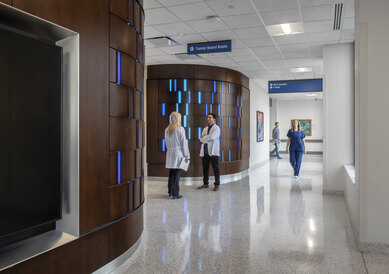
Henry Ford Cancer Institute
Brigitte Harris Cancer Pavilion
Bringing precision medicine, clinical trials, and advanced
therapies together with wellness and support services,
this 187,000-square-foot pavilion combines cutting-edge
technology with spaces designed for healing and hope.
NEUROSCIENCE IS ENTERING ITS MOONSHOT ERA, TRANSFORMING HOW WE TREAT AND STUDY NEUROLOGICAL HEALTH
The neurosciences are entering a period of accelerated growth that will redefine the footprint. Science & Technology Strategist Adam Denmark views neurology as a catalyst for broader change, driven by rising demand and the scarcity of specialists. “The biggest shift we’re seeing is breaking down barriers and bringing disciplines together to accelerate cures and preventive strategies,” he explains, especially as research intensifies around Parkinson’s, ALS, and Alzheimer’s. “Picture integrated hubs where research, imaging, and surgery converge—moving away from clinical silos and toward innovation ecosystems.”
On the clinical front, Dallas Studio Leader Jay Rambo anticipates a more immersive therapeutic landscape: “Neurorehabilitation will incorporate AR/VR modalities that gamify recovery. Wayfinding will become more intuitive and tech-enabled, especially for patients with cognitive challenges.”
Health Design Principal Karthik Ramadurai emphasizes the need for nuance: “The misconception is that neurodiversity requires simplification. What it requires is adaptability,” he explains. Looking ahead, he sees a dramatic shift: “The future is radical personalization—spaces that change lighting, sound, and visuals in real time based on a patient’s cognitive neurological state. Rather than serving as a backdrop, architecture will become a therapeutic instrument.”
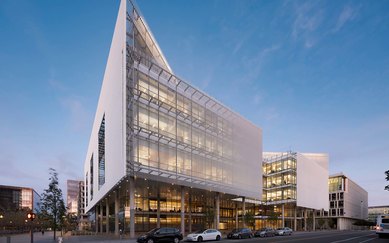
UCSF Joan and Sanford I. Weill Neurosciences Building
Uniting clinical care and research, this landmark facility
advances treatments for brain and nervous system disorders
with flexible clinics, cutting-edge labs, and welcoming spaces
that reduce stigma and foster healing.
Learn more →
TRAUMA-INFORMED AND NEURO-INCLUSIVE DESIGN WILL BECOME STANDARD ACROSS ALL HEALTHCARE SPACES
Behavioral health design is undergoing a long-overdue evolution, driven by the voices of those who have experienced the system from the inside. “We’re finally listening to people who’ve experienced behavioral health crises firsthand. Their insights reshape everything—sightlines, sensory triggers, circulation, lighting,” says Tripti Singh, Senior Medical Planner.
This shift reflects a broader recognition: the built environment can either reinforce stigma or actively support recovery and acceptance. “I’ve seen how lived experience changes the conversation,” Singh notes, emphasizing how direct feedback influences planning decisions and elevates empathy into a design requirement.
The strategies developed in behavioral health—trauma-informed planning, sensory aware environments, and layouts that promote emotional safety—are no longer confined to behavioral spaces. What we’ve learned here is now informing all healthcare spaces as systems realize these principles benefit every patient, not just those in crisis.
Looking ahead, Singh sees the next major shift clearly: “Trauma-informed and neuroinclusive design should be the default, not the exception."
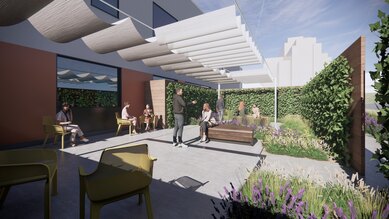
Humanizing Behavioral Health
Explore how innovative design is transforming behavioral
health environments—moving beyond institutional models
to create spaces that are safe, welcoming, and deeply
human-centered.
A clear pattern emerges from these perspectives: the future of care will be defined by a network of responsive environments rather than a single building—integrated hubs that collapse the distance between research and treatment, ambulatory centers that root healthcare in daily life, and human dignity becomes the core metric. Sustainability becomes infrastructure, not aspiration. Technology recedes into the background, surfacing only where it serves. Flexibility is a foundational design principle, and the facility shifts from merely housing care to actively enabling it.
The future of care will not be defined by a single building type or a singular technological leap. It will be defined by the creation of a responsive network of environments that evolve with clinical practice, scientific discovery, and human need.
We won’t get there by waiting for stability. We’ll get there by designing for what’s true today and probable tomorrow—ensuring that flexibility, empathy, and dignity remain the core of every decision.