University of Louisville, J.B. Speed School of Engineering, Engineering Student Success & Research Building
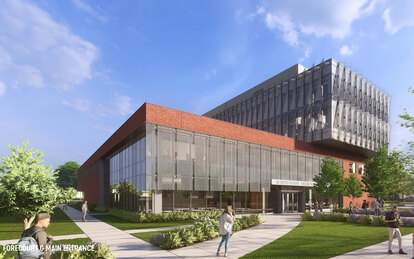
Bringing together engineering education, innovation, research and student life, this multi-function building establishes a hub for the Speed School of Engineering that is a catalyst for the continued expansion of its campus and enrollment.
Client
University of Louisville
Location
Louisville, Kentucky
Markets/Services
Architecture, Higher Education, Interiors, Lab Planning, MEP Engineering, STEM (Science, Technology, Engineering, Math), Structural Engineering
The Engineering Student Success & Research Building brings new energy and greater prominence to the J. B. Speed School of Engineering campus. It upgrades the school’s education and research facilities, adding advanced research laboratories, classrooms and innovation/creation areas. It provides a wealth of student support services, social zones and study spaces, creating a welcoming “home base” for engineering students. Highly transparent and engaging, the Student Success Building demonstrates the university’s commitment to supporting its students and driving engineering education, design, and research.
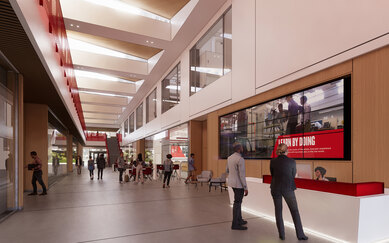
The building design reflects its diverse role on the University of Louisville campus. A two-story brick plinth establishes a pedestrian scale and a welcoming entry to the student-focused areas on the first two levels and complements the existing brick campus buildings. It is topped by a two-story cantilevered glass bar clad with angular expanded metal mesh fins to provide a forward-looking expression to the engineering campus. The Student Success Building’s central atrium offers views into all the spaces, including a display of the diverse engineering activities taking place. At the ground-floor entrance, a central help desk guides students toward tutoring, counseling and other student success services. The Speed School Center for Innovation, along with its new state-of-the-art Makerspace, is equipped with specialized machinery for building protypes and preparing for student competitions in a variety of engineering disciplines.
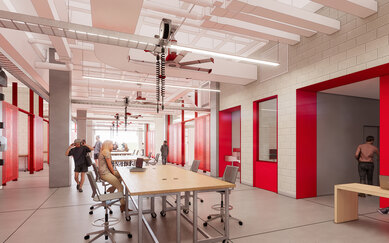
Throughout the building, exposed concrete and structural elements create a casual atmosphere for student hangout zones that include a café, food service, billiards tables and lounge seating.
Upper floors house laboratories for researchers, students and the Conn Center for Renewable Energy Research, which conducts advanced research on green fuels, and sustainable manufacturing and building technologies. The building mechanical and electrical systems were designed to provide research and learning opportunities for the Conn Center, with a geothermal system that diverts heating and cooling needs away from a central plant. When installed in the future, a planned rooftop solar array will provide additional power and serve as a research testing area for the Conn Center. Sustainable concrete was used to construct the building to decrease embodied carbon by more than a third, and waffle slabs were used strategically to reduce the overall volume of concrete used.
The building footprint was oriented to optimize its role as a hub of the engineering campus and a catalyst for future development. The site plan maximizes open space between the new building and adjacent Ernst Hall, establishing them as the first two buildings of a quadrangle as the engineering campus expands southward. The prominent position sends a positive message from all vantage points. Up close, the building is a welcoming home for all students; from afar it is a sleek symbol of boundless innovation and opportunity. SmithGroup was the design architect, laboratory planner and structural engineer of record, working with Luckett & Farley, who served as the local AOR and EOR on this project.