Designing Health Education Facilities for the AI Era
Key Takeaways:
- AI is rapidly reshaping health professions education and redefining longstanding assumptions about academic space design.
- While AI reduces demand for some spaces, it will drive growth in simulation, VR/AR and other tech‑intensive environments. Many existing spaces aren’t shrinking or expanding but transforming entirely.
- To stay relevant as AI continues to evolve, facilities must prioritize adaptability, digital equity and human‑centered design.
Artificial intelligence is transforming health professions in ways that challenge conventional assumptions about academic space planning. From nursing programs to medical schools, dental education to allied health training, some predict AI will result in smaller facility footprints: fewer lecture halls, smaller libraries, reduced administrative offices. The reality is far more nuanced. While AI does compress certain traditional spaces, it simultaneously creates entirely new programmatic demands that we didn’t see coming. The net result isn't necessarily smaller buildings, but fundamentally different ones. Here are three ways AI will reshape health education facilities:
1. The Compression Effect: Where AI Reduces Footprint
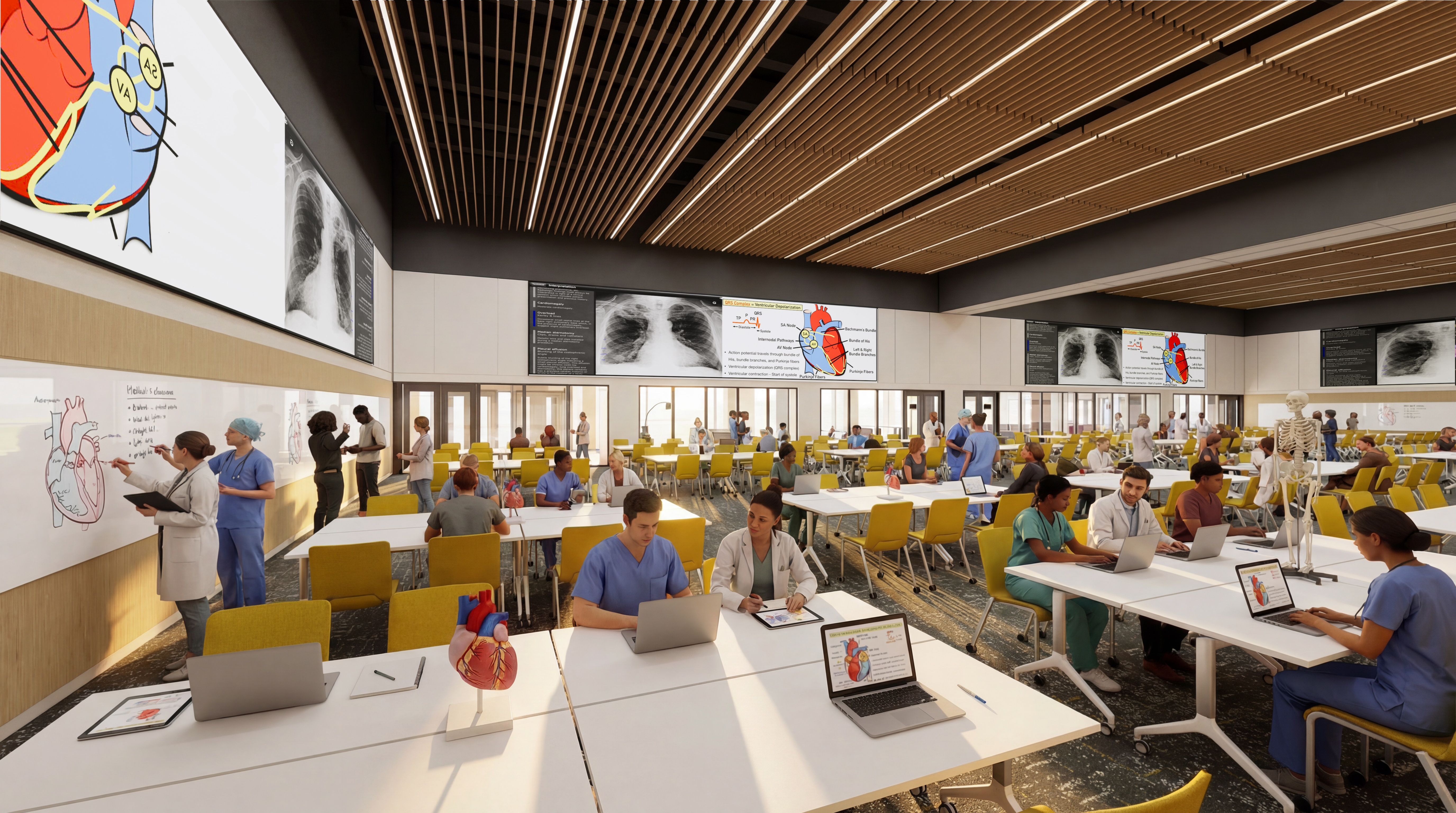
The shift away from traditional lecture-based instruction in health education started well before AI entered the picture, but technology-enabled learning is hitting the accelerator hard. Large lecture halls designed for passive knowledge transfer are giving way to smaller, more flexible learning environments. The flipped classroom model has been gaining traction for years now, where students absorb content on their own time and use class sessions for hands-on application. AI-powered personalized learning platforms are accelerating this trend, with adaptive content delivery that makes synchronous didactic instruction less necessary, instead prioritizing flexible spaces that support team-based learning.
2. The Expansion Effect: New Spatial Demands Created by AI
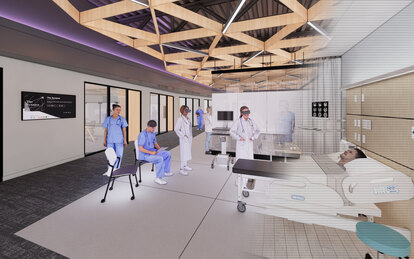
Here's where it gets interesting. As AI compresses traditional spaces, it generates new programmatic requirements as well. Simulation education, already central to health professions training, is experiencing exponential growth. AI-enhanced manikins independently respond to clinical interviews with scenario-specific answers and react automatically to drug treatments through validated physiological models. What used to be a straightforward skills lab has become a complex ecosystem: preparation spaces, simulation rooms equipped with multiple cameras, debriefing rooms with screens for reviewing AI-generated performance data, expanded technical infrastructure to support it all.
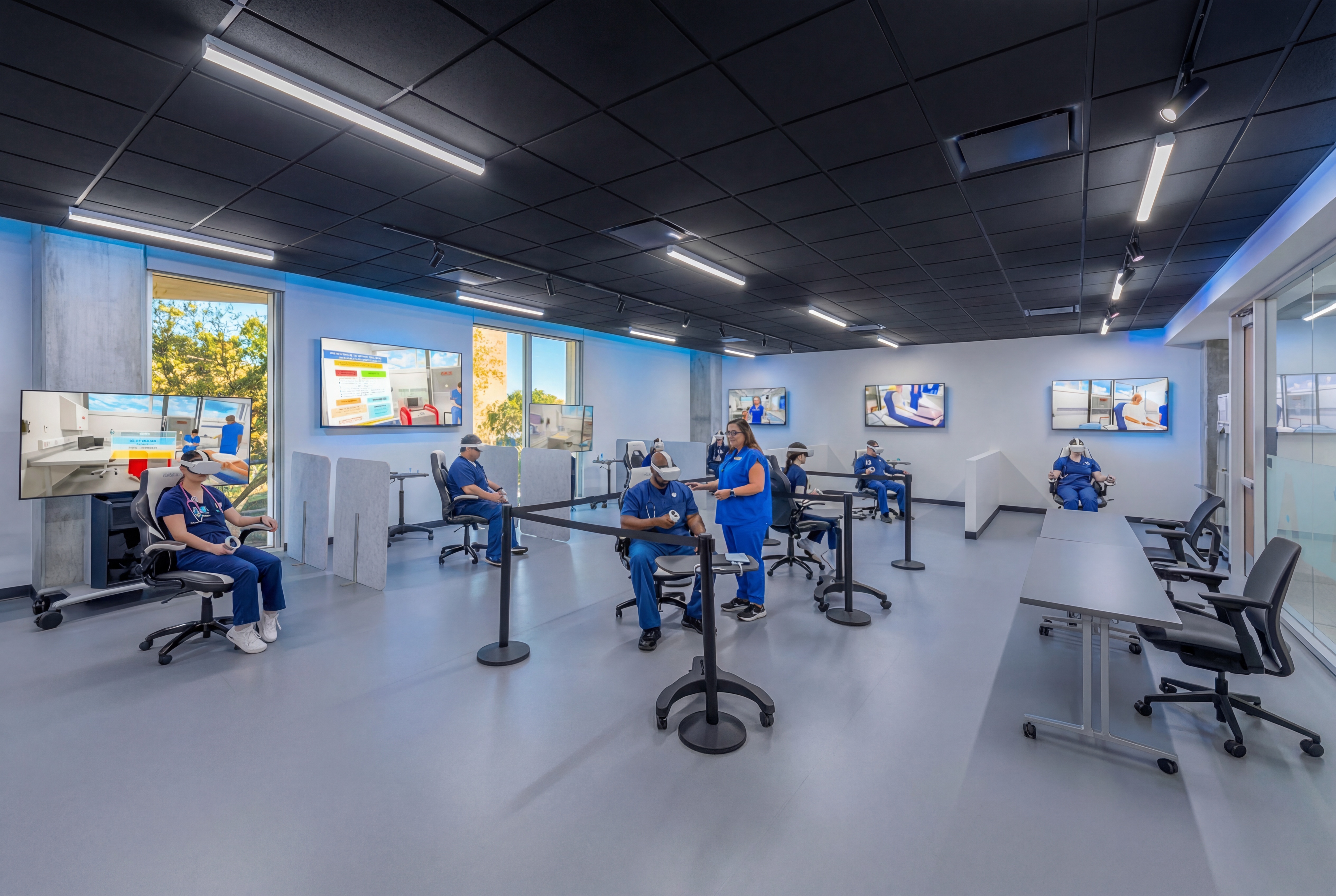
Virtual and augmented reality layers on additional complexity. AI's ability to significantly enhance VR learning means demand will keep climbing. VR platforms require dedicated headset storage and charging stations, equipment distribution centers, and spaces where multiple students can safely navigate virtual environments simultaneously. Multiplayer VR capability allows students from different sites to practice together in the same virtual scenario, necessitating robust network infrastructure and dedicated VR practice rooms. Institutions are deploying both physical AI-enhanced manikins and VR systems in tandem, creating hybrid simulation ecosystems that demand flexible spaces capable of supporting both modalities.
3. Transformed Spaces: Familiar Programs, Unfamiliar Forms
Some spaces don't shrink or expand, but transform entirely. Clinical skills assessment is being reshaped by AI systems that grade clinical reports, provide automated evaluation, and even assist with OSCE case creation. This approach demands transformed assessment centers with video-recording infrastructure for AI analysis that captures student-patient interactions from multiple angles, including new technologies like embedded patient-perspective cameras. They need secure data storage and processing for performance analytics, private review stations where AI-generated evaluations can be discussed with students, and hybrid evaluation rooms where human examiners work alongside AI scoring systems to analyze everything from verbal communication patterns to physical examination technique.
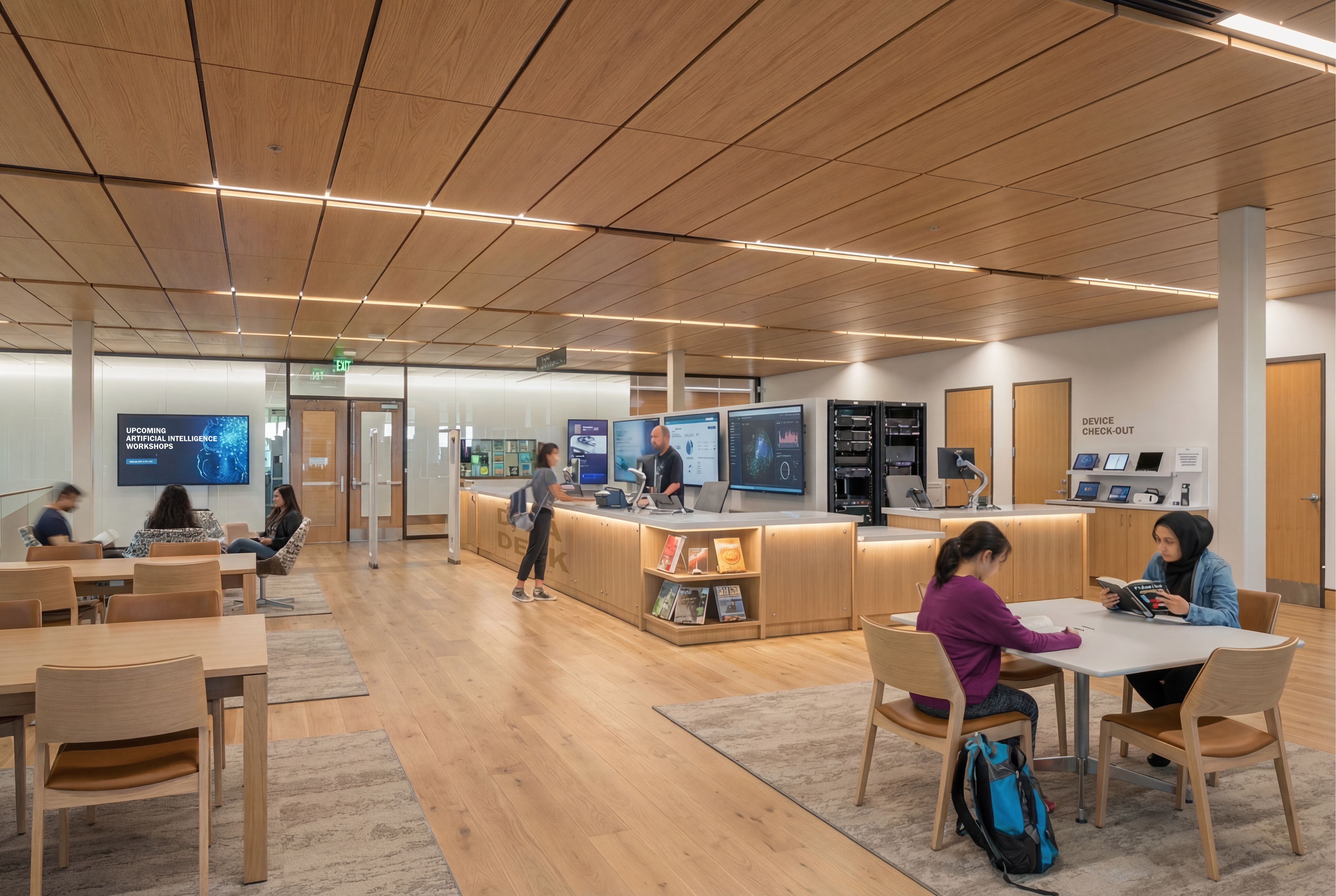
Health sciences libraries started their transformation when collections went digital, but AI is pushing them toward something else entirely. This shift involves repurposing library square footage to support AI-enabled learning and research, with libraries now becoming hubs for teaching students how to use AI diagnostic tools, how to evaluate AI-generated clinical insights, and how to conduct research with machine learning. The traditional reference desk is reshaping to support data science services and AI literacy programming, resulting in a fundamentally different library: less repository, more laboratory for intelligent systems. Digital equity emerges as a critical design consideration as well, creating new spatial demands: technology lending libraries with device checkout infrastructure, digital literacy support centers, high-speed internet access throughout facilities, and community-facing technology access points.
Design Implications: Planning for Perpetual Uncertainty
These shifts create real headaches for facility planners. The fundamental problem is uncertainty. Nobody knows what AI capabilities will look like in five years, much less over a building's 50-year lifespan. This demands design strategies centered on adaptability: abundant power capacity, ubiquitous data connectivity, reconfigurable furniture systems. We must resist optimizing space for today's AI capabilities and instead design for continuous evolution.
Equity considerations become paramount. AI risks widening existing divides if facility design doesn't actively work against this tendency. Universal access to high-quality technology and reliable connectivity must be baked into spatial planning from day one. Community-facing spaces that extend institutional resources beyond enrolled students can help democratize access.
Perhaps most importantly, human-centered design becomes more critical as AI becomes more prevalent, not less. The spaces where students gather informally, where chance encounters spark collaboration, where faculty and learners connect as humans become even more important. The efficient, AI-optimized facility that eliminates "excess" study and social space may prove the least effective learning environment of all.
The institutions that thrive will be those whose facilities can accommodate unknown innovations that will emerge over the next half-century. Tomorrow's nursing school or medical education building may occupy similar square footage to today's. But inside those walls, nearly everything will be different.