Designing People-Centered Transit Hubs: Gateways to Opportunity
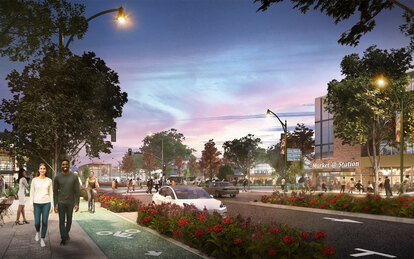
Transit hubs are more than places to catch a train or bus. When holistically designed, they shorten commutes, expand access to jobs and education, support healthier and more independent lives, and strengthen community connections.
Transit investments are experienced at the most basic human scale. By extending the supportive fabric of a transit facility onto surrounding streets, public spaces and adjacent development, transit-oriented neighborhoods become places where people can thrive.
Start with access—then design the whole journey.
Transit hubs, rail stations and mobility centers can be beautifully designed but still fail people if the trip to reach them feels unsafe, confusing or exhausting. People-centered design addresses access as an end-to-end experience: from the walk/roll/bike arrival, bus transfer, drop-off and pick-up zones to the moments of wayfinding and waiting within the building.
Every choice, whether it's crossing the street, locating an entrance, picking a platform, switching lines, finding a restroom, or making that final walk home, shapes the experience of transit at a human scale. The goal is simple: make the easiest choice the safest, most enjoyable and quickest choice.
The California Air Resource Board (CARB) cites research indicating that most transit users won't walk more than 0.25 miles to bus stops or 0.5 - 0.75 miles to rail stations. Quality of experience in that last-mile environment is crucial. Beyond distance, U.S. Department of Transportation (DOT) policies support providing safe, comfortable routes to and from transit to improve the passenger experience and help maximize customer satisfaction and ridership.
- Design for universal mobility. Routes should be short, intuitive and universally accessible– protected from inclement weather and supported by clear wayfinding and rest areas at regular intervals.
- Make transfers feel “one-seat.” Align bus bays, drop-offs and bike parking so transfers are short, legible and protected, especially for riders with children, bags and accessibility needs.
- Prioritize safety through design. Slow traffic with pedestrian-centered design. Daylight intersections, shorten pedestrian crossings, and reduce turning conflicts with strategies like signal timing adjustments and turn restrictions.
- Make navigation simple. Establish clear sightlines with decision points that are obvious even for first-time users and multilingual speakers, providing consistent information that supports the entire trip.
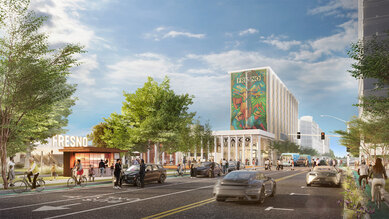
This conceptual rendering of a high-speed rail station in the City of Fresno, CA highlights safe and vibrant connections to surrounding streets.
Put the public realm first to create great civic places.
The best transit hubs do more than move people; they anchor community life. When designed as vibrant civic places, transit hubs build ridership by creating places people enjoy. They also support and generate economic activity. This is placemaking with impact; it improves the riders’ experience and has a ripple effect that strengthens a community’s social and economic fabric.
The American Public Transportation Administration (APTA) reports that every $1 billion invested in public transportation nationwide generates $5 billion in long-term economic value and supports tens of thousands of jobs. The U.S. DOT's Federal Highway Administration notes that “road diet” lane reductions are associated with a 19–47% reduction in overall crashes, while supporting a more community-focused Complete Streets environment.
- Design the “front porch.” Provide generous, shaded entries with active edges and a clear relationship to the street for welcoming and safe arrival at all hours.
- Build identity and orientation. Use form, materials and landscape elements to make the station a recognizable landmark.
- Program for daily life. Retail, flexible community services, music and public art co-created with local communities can transform wait time into productive or enjoyable time.
- Provide comfortable infrastructure. People-centered lighting, shade, wind protection, seating variety and acoustics are essential, especially for longer waits and transfer hubs.
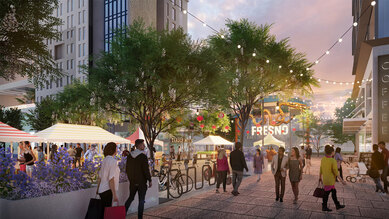
Conceptual rendering of a high-speed rail station in the City of Fresno, CA with active public space
Treat equity as a design driver.
Equitable transit outcomes don’t happen automatically. They come from deliberate choices about who the project serves, which barriers it removes and how investments are targeted. A people-centered approach starts by asking “Who benefits, who is burdened, and who gets to decide?” Then it turns those responses into design decisions addressing access, amenities, safety, affordability and community reinvestment.
Mixed-use Transit-Oriented Development (TOD) with businesses and housing is a win-win for both transit agencies and communities. The Public Policy Institute of California (PPIC) emphasizes the benefits of workplace proximity to transit, with employment density more strongly associated with transit ridership than residential density. A California analysis by the Center for Neighborhood Technology (CNT) found lower-income households drive nearly 50% fewer miles when living within a quarter mile of frequent transit and 25–30% less within a half mile than similar households living farther away.
- Map barriers with the community. Use community engagement to pair data such as crash history, heat exposure and disability access gaps with lived experience to identify where the system is failing people and prioritize improvements.
- Design for inclusivity. Go beyond code compliance to improve access, safety and comfort for riders of all ages and abilities.
- Co-locate community-serving uses. Help riders unlock opportunities with each trip with access to services like childcare, workforce assistance, healthcare resources and community rooms.
- Plan for equitable reinvestment. Utilize innovative phasing, value-capture strategies and partnerships to fund public realm improvements that support local business and prevent displacement.
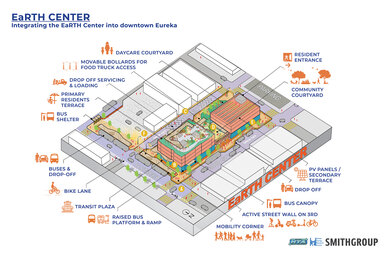
Concept diagram of the EaRTH Center, City of Eureka, CA, showing mixed uses, amenities and downtown integration
Build transit hubs as catalysts for vibrant neighborhoods.
People-centered transit depends on what surrounds the station. The question isn’t just “How do we get people to and from the transit building?” It’s “How do we make the surrounding district work well without requiring a car?” That means designing a connected, low-stress transportation network and pairing it with a mix of vibrant uses that support daily needs, especially housing so more people can live within a comfortable walk, roll or bike ride to reliable transit.
- Build a continuous safe network. Provide protected bike/walk routes that connect neighborhoods to station entries, schools, jobs and parks—prioritized where demand and risk are highest.
- Coordinate curb operations. Manage ride-hailing, deliveries and micromobility so they don’t conflict with transit access or pedestrian safety.
- Integrate transit with housing and essential services. Provide diverse, affordable housing alongside grocery stores, amenities and open spaces to minimize first/last mile travel and reduce car trips.
- Use street design to deliver Vision Zero. Implement speed management, intersection safety and predictable crossings to support a goal of zero fatalities or severe injuries.
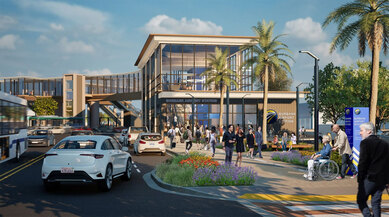
Conceptual rendering of Burbank station for California high-speed rail
People-centered transit is more than an infrastructure design process; it’s a comprehensive approach that engages community needs and civic aspirations. When we design for the full journey, elevate the station as a civic place, treat equity as a design driver, and build mixed-use districts around transit hubs, we deliver transportation solutions that connect people to both destination and opportunity.